Guide
How Does SEO Work? Crawling, Indexing and Ranking Explained
SEO works by making your web pages the best available answer to what people search for, and making sure search engines can find, understand and trust those pages. Search engines crawl the web, store what they find in an index, and then rank indexed pages for each query using hundreds of signals. SEO is the work of influencing each of those three stages in your favour.
By Asad Ullah, FounderUpdated 19 October 20264 min read
In this article
01
Step 1: Crawling — how search engines find your pages
02
Step 2: Indexing — how search engines understand your pages
03
Step 3: Ranking — how search engines choose the order
04
What SEO actually involves day to day
+ 4 more sections, FAQ and next steps
In one sentence: search engines crawl → index → rank; SEO makes your site easy to crawl, worth indexing and the most relevant, trustworthy result to rank.
Step 1: Crawling — how search engines find your pages
Google uses automated programs (Googlebot) that follow links from page to page, fetching the HTML and increasingly rendering JavaScript to see what a user would see. If a page isn’t linked from anywhere, is blocked by robots.txt, or returns errors, it may never be crawled. XML sitemaps, clean internal linking and a healthy server all help here — this is the domain of technical SEO.
Step 2: Indexing — how search engines understand your pages
Once crawled, a page is analysed: its words, headings, images, structured data, links and signals like canonical tags. Google decides what the page is about, whether it is a duplicate of something else, and whether it is worth storing. Thin, duplicated or low-value pages are often crawled but not indexed. Clear titles, descriptive headings, useful content and accurate schema markup improve how a page is understood.
Want this done for you?
Our free growth plan applies everything in this article to your site: three opportunities, their value and the cost to win them. No obligation.
Step 3: Ranking — how search engines choose the order
For each search, Google pulls candidates from the index and orders them. The exact algorithm is secret and constantly updated, but the main families of signals are well established:
- Relevance — does the page match the meaning and intent of the query, not just the words?
- Quality and helpfulness — is the content original, accurate, complete and written for people? Google’s guidance on experience, expertise, authoritativeness and trust (E-E-A-T) sits here.
- Authority — do other reputable sites link to or mention the page and the site? Links remain one of the strongest signals.
- Usability — is the page fast, mobile-friendly, secure and stable (Core Web Vitals)?
- Context — the searcher’s location, language, device and the freshness the query calls for.
What SEO actually involves day to day
Agencies and in-house teams translate those signals into recurring work:
- Keyword and intent research — finding what your customers search and what kind of page they expect (a guide, a product page, a comparison).
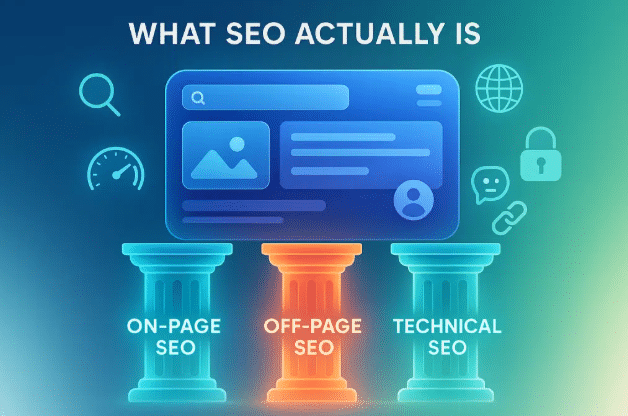
- Technical SEO — fixing crawl, indexation, speed and structure problems.
- On-page SEO — titles, headings, content, internal links and schema on each page.
- Content — creating and refreshing pages that answer searches better than competitors.
- Authority building — earning links and mentions from relevant, reputable sites through digital PR and outreach.
- Measurement — tracking rankings, traffic and, crucially, enquiries and revenue in Search Console and GA4.
How AI search changes the picture
Google AI Overviews, ChatGPT search and Perplexity now generate answers by reading and citing a handful of pages. The underlying mechanics are the same — crawl, understand, trust — but the output is an answer with citations rather than a list of links. Pages that answer clearly, are well structured and come from recognisable, authoritative sources are more likely to be cited. We cover this in our AI SEO services and our guide to AI-ready SEO.
How long does SEO take to work?
Technical fixes can show within days to weeks once Google re-crawls. New content typically takes one to three months to settle into its ranking range. Competitive commercial keywords usually need three to six months of consistent work, sometimes longer. Anyone promising page-one rankings in two weeks is either targeting keywords nobody searches for or doing something that will get you penalised.
Does SEO still work in 2026?
Yes — but the easy tricks don’t. Keyword stuffing, bulk directory links and mass-produced thin content have been actively penalised for years. What works is the unglamorous combination of a technically sound site, content that genuinely helps, and authority earned from real publications. That is also exactly what AI systems reward.
Frequently asked questions
How do search engines rank websites?
They crawl pages, index their content and then order results for each query using signals for relevance, quality, authority, usability and context.
What is the difference between SEO and paid search?
SEO earns visibility in the organic (unpaid) results; paid search buys ads at the top of the page. SEO compounds over time; ads stop when the budget does.
Can I do SEO myself?
For a small site, much of it — see our guide on how to do SEO yourself. Competitive markets and technical problems usually need specialist help.
How much does SEO cost?
UK agency SEO typically costs £300–£3,000+ per month depending on scope. See our pricing and our guide to SEO costs.
Want SEO explained for your specific website? Book a free consultation and we’ll show you where you stand.
Next steps
Related services and guides
What is SEO?
Plain-English explainer.
SEO strategy guide
Plan SEO that actually ranks.
SEO services UK
Technical, content and PR from one team, from £450/month.
FAQ
Questions we get asked
How long does SEO take to work?
Technical and local improvements often show within weeks; competitive organic rankings typically take three to six months and keep improving after that.
Is SEO free?
Organic clicks cost nothing, but the work to earn them — content, technical fixes, authority — costs time or money.
Does SEO still work with AI search?
Yes. AI Overviews and assistants cite the same credible pages Google ranks; good SEO is what gets you cited.
What should a small business do first?
Set up Search Console and Google Business Profile, make the site fast, and write one clear page per service.
Want help applying this?
Send your URL and we will apply the guide to your site in a free written growth plan within three working days.